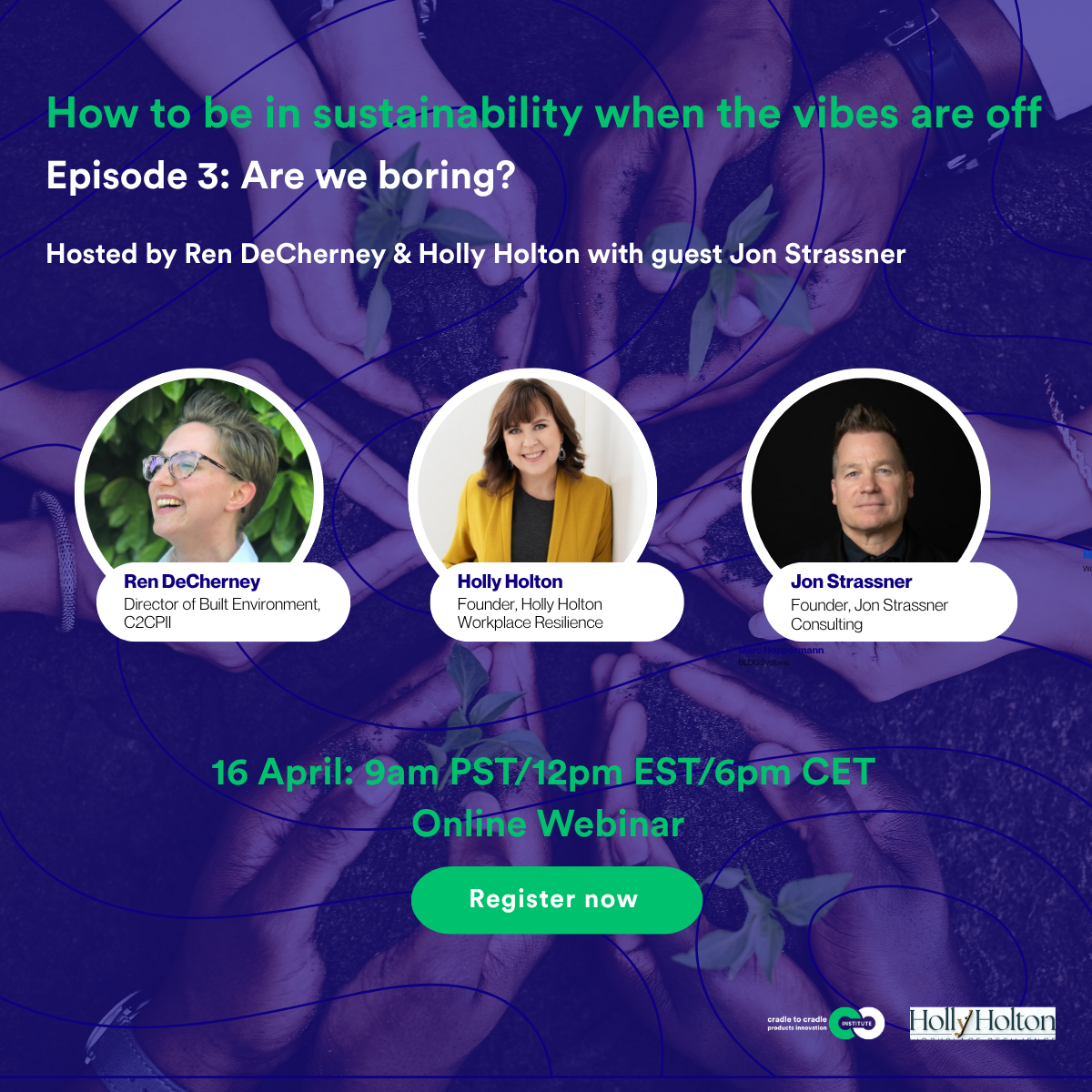
Ep.3: Are we boring? from "How to be in sustainability when the vibes are off"
Key Takeaways
The Diagnosis: We're Giving People Two Terrible Choices
The conversation opened with a deceptively simple game: find the fake conference session title:
Investing in carbon: from measurement to impact
How we build a low carbon future at scale
Healthy indoor air = healthy kids: material health impacts in schools
What’s what in voluntary reporting in 2026
Ren asked Holly and Jon to identify the fake. Turns out they were all fake and they were completely indistinguishable from real ones. If we can't tell our own session titles apart from parody, we definitely have a problem.
Strassner, who spent years distilling sustainability narratives at HumanScale before launching his own consulting practice and podcasts, traced the problem to a binary that the movement has built for itself. As he explained, citing architect and sustainability advocate Eric Corey Freed: the field tends to offer audiences only two options. The first is dystopia: a grim 50-year outlook of deserts and disaster. The second is austerity: a demand that people sacrifice convenience, comfort, and aspiration in service of the planet.
"Neither of those choices is good. And neither of those choices should be presented" explained Jon.
Holly, whose coaching practice is built on the intersection of mindset and mission, immediately connected this to how humans actually process information.
"We think we're moved by logic and rationality and data and we're not," she said. "We're emotional creatures focused on survival and safety. It's emotions first."
So now we have a movement that has been speaking to the left brain for decades when the right brain is what leads people to make the changes we are promoting.
The Savannah Problem: Why Climate Threats Don't Register
One of the session's most clarifying moments came when Strassner introduced what he calls the Savannah Principle. It’s the idea that human brains are still wired for the ancient environment in which they evolved.
"If I look up and there's a lion running toward me, I get it. That's a threat," he explained. "But if you tell me that if I don't recycle this Coke bottle, in 50 years it's going to be 17 degrees hotter in July I'm not going to react to that. I'm not going to see that as a threat."
Climate change, in other words, is a lion that doesn't look like a lion. It's abstract, distant, and diffuse which means it bypasses the cognitive systems that motivate behavior change. Pair that with the bystander effect (the more experts we put on a podium, the more everyone else assumes those experts will fix the problem), and you have a movement that is systematically undermining its own momentum.
The antidote, all three agreed, isn't more data. It's better stories. Strassner's working maxim for 2026:
"Data informs. Storytelling transforms." Jon, Holly and Ren encouraged practitioners to get personal because if an audience has no emotional connection to a message, they won't retain it. "People aren't going to remember what you tell them. They're not going to remember what you show them. They'll only remember how you made them feel” said Jon.
Gatekeeping, jargon, and our problem with purity tests
Ren, Holly and Jon all noted that they have been told, at different points in their careers, that they weren't qualified to do sustainability work, but kept going.
Rather than dismiss those experiences, they used them to name something important: sustainability has developed a language culture that functions less as communication and more as gatekeeping.
"Language in sustainability has become both gatekeeping and a purity test," Ren observed. "You have to know the lingo to get in the tent and then once you're in the tent, you have to keep proving you belong. It ends up keeping us all stuck."
Strassner pointed to acronym-dropping and data-citing as symptoms of the same ego-driven impulse.
"A lot of times when we want people to know how smart we are, that's when we use all the stupid acronyms and start dropping the data. Like 1.5 degrees, don't let the earth warm past 1.5 degrees. How many people have even heard that? And how many people know what the hell it means?"
He told Ren and Holly he keeps telling folks:
"Your ego is not your amigo." Putting ego in the back seat is what creates space to read the room, adapt the message, and actually connect with people who aren't already converted.
Embracing the nuance
Jon shared a piece of advice that he got from the early podcasting days. His guest Russell Goldberg of Stick Bulb told him
"Don't wait until you're right before you use your voice." Jon noted it was so powerful that that he has carried with him ever since.
For a field that tends to prize credential and precision, it feels radical to embrace not being perfect but Strassner argues it's essential.
"None of us are perfect human beings," he said. "Embrace the hypocritical. Don't let perfect stand in the way of good."
Holly connected this directly to nervous system science. Admitting uncertainty feels genuinely threatening because our brains are wired for certainty and safety. Acknowledging that this discomfort is physiological and not moral makes it easier to move through it.
"Get comfortable being uncomfortable," she encouraged. "That's where the growth is."
Ren offered a practical reframe for anyone frozen by the scale of the problem: pick one thing you’re really interested in and go hard at it. When she led her own firm PVC-free, it was because she was passionate about material health, it was high impact, and she could do it from her position in the firm.
She noted you can just "find the lever you've got and yank it. Just yank the hell out of it."
Holly added the neurological logic:
"Action fights overwhelm. We also don't process things that seem too big. If you just do one thing, it doesn't matter how small, you break the paralysis."
Where do we go from here: what better messaging looks like
So how do you actually reach people who aren't already in the room?
Strassner's answer: meet people where their hot buttons already are. He shared a conversation with industry colleague about furniture decommissioning, arguably one of the least glamorous topics in the built environment space. The breakthrough came when they stopped leading with "landfill diversion" and started asking: what does the client actually care about? Is it budget? Brand perception? Employee wellness?
"Nobody wants a used desk," Strassner said. "If you get the used desk, that's a message from upper management." But reframe it the way fashion reframed secondhand clothing as vintage, as intentional, as values-aligned and suddenly you have a different conversation.
Ren uses the same approach in her work with designers. She trains sales reps to find the sustainability story that genuinely resonates with them personally, then let that passion lead. The reps and brands who resonate are the ones who aren't performing enthusiasm, they've found their own version of the thing they actually care about.
Holly articulated the underlying skill: radical empathy. "Check that non-amigo ego at the door and ask: what does this person care about? Can I see the world through the lens they see the world through?"
She and Ren pointed out that this is also something AI cannot replicate. The human ability to intuit what matters to another person and translate it into meaningful design or recommendation, that's the irreplaceable value practitioners bring.
what to let go of and what to double down on
To close, Holly asked Strassner the two questions she asks every guest.
What does the industry need to let go of in 2026? Ego says Jon.
"Embrace your inner ability to suck," he said. "Little kids don't give a damn if they're bad at something, it doesn't stop them. When we grow up, we become terrified to try anything we might not be great at. That's the ego talking."
What does the industry need to double down on? Curiosity.
"There are people out there who could become experts if they're curious. Curiosity killed the cat, but satisfaction brought him back. You get that satisfaction because you figure it out." Holly added that curiosity also lowers conflict, builds connection, and creates the psychological safety that makes hard conversations possible.
Here’s how Jon uses music to keep up with the work:
His favoritte pump-up jam: Jack and Diane
His current go-to song to spark creativity: Pink Pony Club