Blueland: A powerful clean without compromise
Blueland was born from a simple idea: the products you use to clean your home shouldn't compromise the health of the planet - and the people living in it.

The Blueland team set out to answer a simple question: what if everyday cleaning products could be designed without single-use plastics and with far fewer resources while delivering the same level of performance? In an industry built on shipping water in disposable single-use bottles, they reimagined the model entirely. By removing the water and redesigning the format, Blueland created concentrated dry tablets that provide an effective clean without the waste of conventional products. That decision continues to guide how Blueland approaches design: ingredients are chosen for performance and material health; formats are built for repeated use, and packaging is reduced to components that can be recovered or recycled.
The shape of a reusable system
Conscious consumption is the foundation of Blueland’s circular approach. Tablets are formulated as dry concentrates in order to reduce transport emissions and eliminate the need for disposable packaging. Each ingredient is selected with attention to the highest ingredient safety, ensuring that performance is matched with a lower environmental load. Blueland provides refillable bottles and vessels, engineered to remain durable across multiple refill cycles.
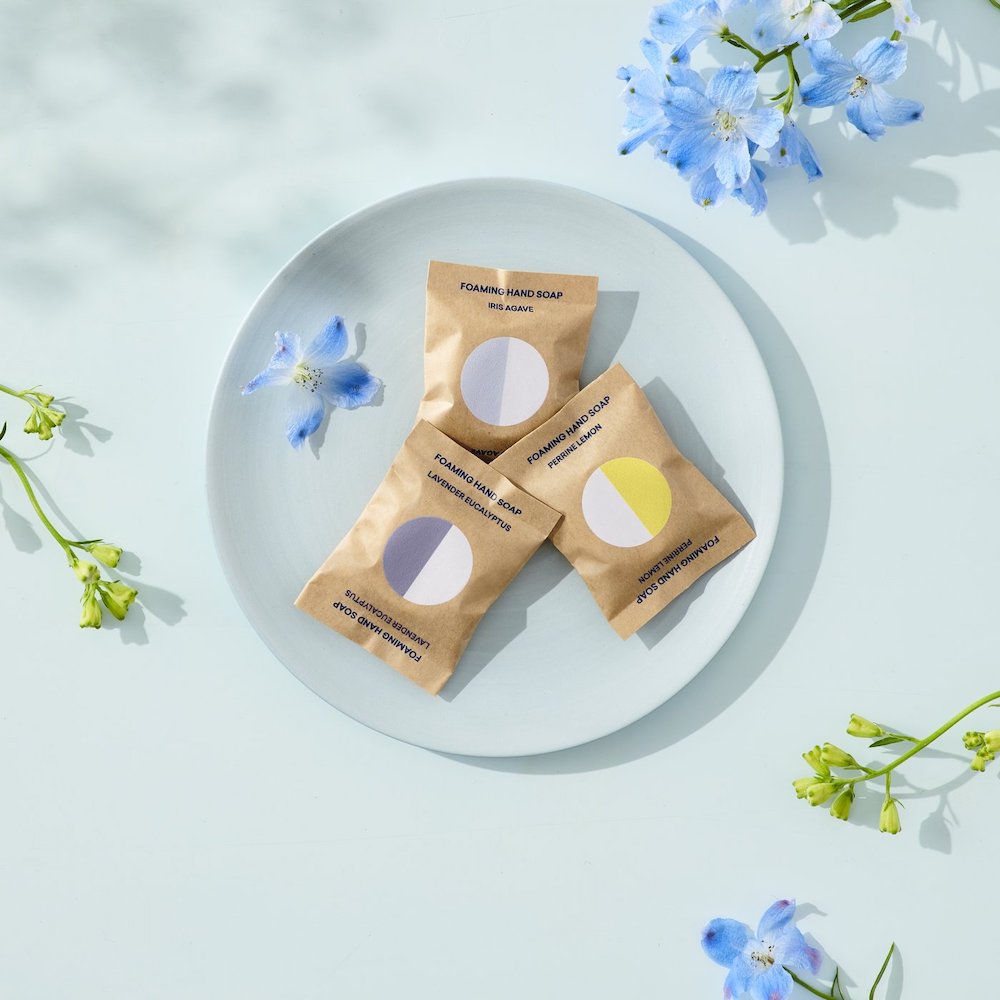
Refill wrappers are plastic free and designed for recovery and composting; they can also be sent back to Blueland for the facilitation of industrial composting. Shipping materials rely on recyclable paper and minimal components.
In production and fulfillment, Blueland prioritizes partners who demonstrate clear, measurable practices in resource efficiency and process improvement. The result is a supply chain shaped to support reuse.
.png)
Working with the Cradle to Cradle Certified® framework
“Cradle to Cradle Certified® has pushed us to look beyond just one aspect of sustainability. Now we look at the impact of Blueland as an organization holistically across material health, circularity, water stewardship, and social fairness.”, Blueland team explains.
The process of the Cradle to Cradle Certified® certification pushed Blueland to meet stricter ingredient thresholds, expand knowledge sharing with suppliers, and strengthen internal alignment around measurable progress. It also supported more detailed material reviews, giving the team the tools to track changes with precision and plan reformulation work with greater clarity.
The Cradle to Cradle framework and certification has become integral to everyday decision making, directing attention to the materials that matter most, informing how suppliers are evaluated, and providing a shared reference point for teams working across formulation, packaging, and operations. The result is a method for progress that is structured, repeatable, and integrated into the way products are developed.
Advancing the refill model
Blueland is expanding its work on concentrated formats, exploring new ingredients and tablet compositions that strengthen material health while maintaining performance. New products in development follow the same principle as the current line, reduce what is unnecessary, and design each component for repeated use.
The focus extends beyond formulation. The team is evaluating opportunities to expand Cradle to Cradle Certified® to a wider range of products.
“We’re currently working to expand Cradle to Cradle certification across even more of our products as well as new products in the pipeline,” the team notes, highlighting how the framework shapes both near term improvements and long-term planning.
Systems work is another priority. Blueland is building stronger methods for tracking materials through each stage of use, improving how product data is organized, and creating tools that support clearer decision-making during development.
“We’re always exploring ways to better our impact without compromising product performance,” Blueland team adds, underscoring how design choices and operational work move in parallel.
The direction is steady, built on what works, challenging what needs to evolve, and applying each lesson to the next generation of products.
.png)
-1779442382.png)
Advice for newcomers to Cradle to Cradle Certified®
Blueland encourages companies to begin by learning the structure of the standard and understanding how its requirements connect to real products and systems. The team notes that certification moves more smoothly when internal alignment is in place and when suppliers are involved early.
“Understand the framework and its core principles.”
They emphasize that progress depends on coordination across teams and clarity around material choices, supported by tools that help track data and refine decisions over time.
“Recognize that achieving C2C Certified® is an iterative process. It may take time to meet all the criteria, so set realistic goals and milestones along the way.”
For Blueland, the most valuable early step is building foundational understanding. When teams know what the framework asks for and why it matters, every improvement becomes easier to plan, document, and build upon.
Building the next cycle
At Blueland, progress comes from paying attention to how decisions connect across the whole system. The team continues to refine how materials are evaluated, how formats support reuse, and how design choices shape what happens after a product leaves the factory. Their work moves toward a model where each component plays a defined role, remains traceable, and can be managed with greater clarity over time.
“We’re always exploring ways to better our impact without compromising product performance,” the team explains. “Certification helps us think long term about how to design toward that.”
This perspective has grounded their next phase, focusing on strengthening the methods behind development and ensuring that each new product enters the system with clearer expectations for use, recovery, and future improvement.