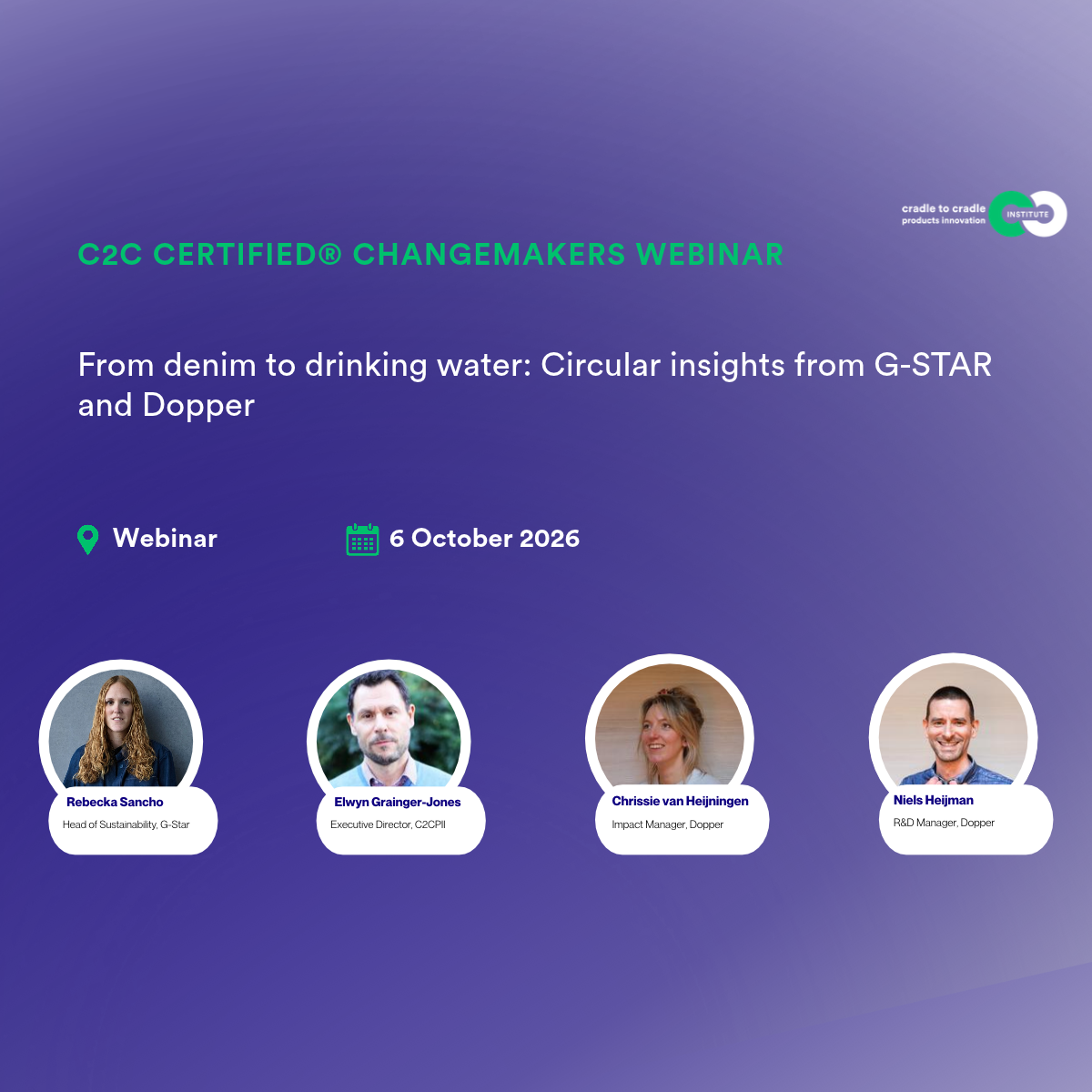
From Denim to Drinking Water: Circular Insights from G-Star and Dopper
Key Takeaways
Moving from products to systems
A recurring theme was that true circularity starts with systems thinking.
For Dopper, the challenge is not simply designing a reusable bottle, but creating a system that enables people to choose tap water over single-use alternatives. This requires collaboration across a wide range of stakeholders, including consumers, businesses, public institutions, policymakers, and infrastructure providers. Access to safe drinking water, refill infrastructure, and consumer convenience are all part of the solution.
The discussion highlighted that scaling circular solutions requires engagement across the entire ecosystem, not only within a company's own operations.
Designing products for circularity
At G-Star, circular design requires looking beyond the overall garment and optimizing every component.
Key considerations include:
Increasing garment durability and extending the number of wears.
Designing products that can re-enter technical or biological cycles.
Assessing every component, from fabrics to threads, labels, buttons, and trims.
Evaluating the impact of material choices such as polyester versus cotton trims and sewing threads.
The conversation highlighted the complexity of making products with the lowest possible impact while maintaining quality, performance, and customer expectations.
The challenge of balancing circularity and performance
An important insight from G-Star was that circularity often involves trade-offs.
For example:
Recycled cotton can support circularity goals but may sometimes present durability challenges compared with virgin fibres.
Standardization of fabrics and trims could improve recyclability, but differentiation and design variety remain important in fashion.
Fashion operates on seasonal cycles, while circularity requires long-term thinking and investment.
Rather than avoiding compromises, businesses need to understand the underlying complexity well enough to make informed and responsible decisions.
Circularity is not about eliminating trade-offs. It is about making better trade-offs.
Material health and consumer trust
Dopper emphasized that material health is a non-negotiable area.
For products that come into direct contact with food and beverages, consumer trust depends on knowing that materials are safe at the molecular level. Cradle to Cradle Certified® was highlighted as a valuable framework because it provides independent verification of material health and helps build confidence among consumers and business partners.
The discussion also touched on end-of-use considerations, including take-back systems, disassembly, and the recovery of valuable components after a product's first life.
Collaboration across the value chain
Both companies stressed that circularity cannot be achieved alone.
A key insight was that sustainability risks and opportunities increasingly sit further upstream in the supply chain. By engaging suppliers and understanding material flows deeper into the value chain, companies can not only reduce risks but also unlock opportunities for better product design and innovation.
G-Star's experience with Cradle to Cradle Certified® demonstrated the value of open innovation. Rather than keeping circular breakthroughs proprietary, the company shared learnings and technologies openly to accelerate progress across the industry.
Consumer behaviour remains decisive
The discussion highlighted that even the best circular products will not create impact unless consumers adopt them.
Dopper's research showed that convenience is one of the strongest drivers of behaviour change. The company succeeded by making drinking tap water easy, attractive, and even fun, removing barriers instead of asking consumers to make sacrifices.
Fashion presents a different challenge. Consumers primarily choose clothing because of design, fit, and style. Sustainability is rarely the primary buying decision, although it is increasingly expected as a baseline requirement.
Rebecka indicated simple but strong principles like: If you buy a T-shirt today, it should simply be organic.
At the same time, companies face the challenge of making sustainability information both more comprehensive and easier for consumers to understand.
Digital transparency and AI
The conversation explored the emerging role of Digital Product Passports (DPPs) and AI.
Participants noted that published sustainability data must be based on robust primary data rather than assumptions. This is an area where verified frameworks such as Cradle to Cradle Certified® can help by providing reliable, product-level information.
Elwyn highlighted the potential role of AI and digital tools in making sustainability information more accessible and relevant at the point of purchase. As sustainability data becomes more complex, AI may help translate that complexity into simple and actionable consumer guidance.
Regulation: catching up with sustainability leaders
Both companies agreed that legislation is increasingly moving in the direction that sustainability pioneers have advocated for years.
Dopper noted:
Sustainability today becomes legal compliance tomorrow.
Regulatory developments such as the Green Claims Directive, ESPR, Digital Product Passports, and EMPCo are reinforcing the need for credible, verifiable product information.
For companies, trusted overarching certifications such as Cradle to Cradle Certified® can help communicate performance clearly while preparing for future compliance requirements.
At the same time, G-Star emphasized the importance of staying proactive rather than waiting for regulation to dictate action. Companies that move first often gain valuable experience and resilience.
Business value and resilience
Circularity was discussed not only as an environmental strategy but also as a business strategy.
Examples included:
Resale models creating additional value for G-Star products.
Better understanding of materials reducing long-term supply chain risks.
Greater resilience through long-term thinking and circular business models.
Trust and brand differentiation through independently verified sustainability performance.
Convincing leadership and boards often requires demonstrating these business benefits alongside environmental outcomes.
Closing reflection
Although G-Star and Dopper operate in very different markets, both demonstrated the same core lesson:
Circularity is not a product feature. It is a system transformation.
Whether designing a pair of jeans or enabling access to drinking water, meaningful change happens when companies look beyond their own products and work together to redesign the systems in which those products exist.