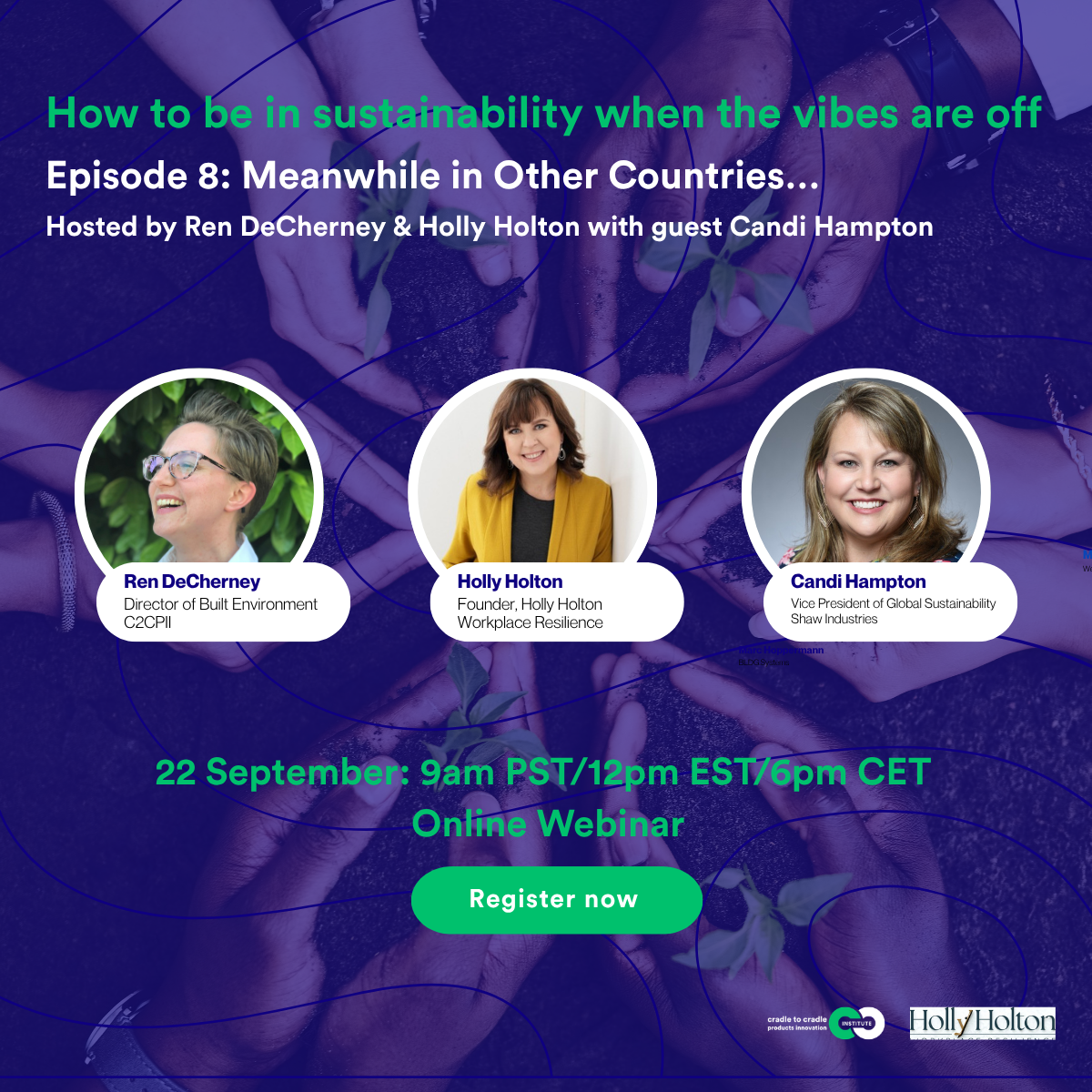
Ep.8: Meanwhile in Other Countries... from "How to be in sustainability when the vibes are off"
Key Takeaways
Turns out everyone is asking for sustainability, we’re all just using different words for it
Yes, the vibes in sustainability (really, everything) are off right now, but from her global role Candi reports that designers and clients are still asking about sustainability metrics when selecting products. “I really think one of the interesting things when you talk about global markets is not actually how different their sustainability expectations are, but actually how much they have in common. It’s a spectrum: each market in and of itself has a slightly different level of maturity and slightly different levers in which it drives those intended outcomes.”
The only difference she sees between the countries is the terminology and the order of priority. Some clients ask about material health or product chemistry, some ask for the carbon footprint or a reduced climate impact, or they ask about circularity or reuse. No matter what words they use, “it's about making sure that the information that they have is credible, that it's transparent, that it's independently verified” Candi emphasized.
What’s new? It’s an emphasis from teams to understand how products contribute to the spaces they are designing and support the people using the spaces. Customers are increasingly educated and they're not just checking boxes anymore. They want to understand how their material choices connect to real outcomes.
But sometimes it feels like WHACK-A-MOLE
From Holly’s 15 year’s experience as a sustainability director for a flooring manufacturer, she said navigating the asks from designers in different regions sometimes just feels like playing whack-a-mole. Every new regulation, certification requirement, or customer inquiry felt like a new ask, often from a customer who didn't fully know what they were asking for. Ren highlighted this as well, and the manufacturers she speaks to often complain that they feel like they are simply reacting to requests, rather than proactively developing a coherent approach.
With her engineering background, Candi's approach at Shaw has been to build a durable internal framework rooted in Cradle to Cradle principles for over 25 years. By using a consistent and forward-looking framework like C2C Certified®, the company doesn't require a fresh response to every individual regulatory or customer demand. The framework creates consistency across the global supply chain, guides product design from the very beginning, and keeps Shaw ahead of the regulatory curve rather than scrambling behind it.
"It's not just about the certification. It's about the principles of design choosing materials that are healthy, circular, and low-carbon from the start, and building that expectation into the supply chain." Candi pointed out.
For manufacturers just getting started, Candi's advice was to adopt a similar framework, and not to try to build a bespoke response to every ask. Find a holistic framework and build around it. Holly added a good way to start is to find the leaders already doing this well. Follow their lead and it’s less scary – it’s less about inventing a new thing, it’s just making commitment and moving forward.
WHAT DESIGNERS CAN DO RIGHT NOW
In her global work with designers, Ren hears designers ask repeatedly how they can work with manufacturers on sustainability initiatives, designers who want to know what actually works. Her advice these days is to reframe the ask around your end goal: rather than asking a manufacturer, "Do you have an EPD, an HPD, a Cradle to Cradle certification?" try instead, "My client cares about healthy indoor air quality. What can you help me with?"
Both Candi and Holly said for manufacturers, this is gold. Framing sustainability as an outcome rather than a checklist is easier for manufacturers to proactively address. Focusing on the tangible outcome of a sustainability ask also makes it harder to cut in a budget, easier to defend to a client, and more collaborative.
"Just a certification is not the answer. Maybe it’s safe materials for the space, or healthy indoor air quality. Once you understand what the outcome is, it’s easier to find the trusted partners willing to work with you towards that goal." said Ren.
Holly's emphasized that designers have more power than they often feel they do. Manufacturers are listening to them and the market is responding, even if it feels slow at times.
WHAT’S COMING
Candi's had a pragmatic view of the current US market: work hasn’t stopped and designers haven’t disengaged just because the politics are complicated. Markets don't operate independently anymore and what Europe and California require today becomes the global business standard of tomorrow, regardless of the federal mood in Washington.
"What we see happening in Europe today is going to spread around the world. It's already getting built into business practices that continue to propagate and spread, regardless of the vibes with the politics here." Noted Candi.
Candi noted two major trends she sees as growing in the next few years that she urged designers and manufactures not to sleep on:
First: human health connection. Environmental sustainability is increasingly understood not just as protecting the planet but as protecting the people in the spaces we design. Frameworks like WELL Building Standard are growing globally because the evidence is mounting that the spaces we occupy daily affect our health more than our doctors do. That trend is accelerating in all markets.
Second: alignment. The industry is awash in data and now the challenge isn't getting more of it, but how to make it actionable and speaking the same language. Candi is a vocal supporter of the Common Materials Framework (through mindfulMaterials) as a mechanism for industry-wide alignment that lets products be compared on a more level playing field.
"The complexity is real and it's probably going to get worse. Finding and keeping that alignment is so important and it's also evidence that engagement is real. Sustainability is real, and people want it."
WHAT’S A DESIGNER TO DO NOW
Holly asked Candi for advice on what designers should double down on and what they should let go of and she had some practical advice for designers in any region:
Double down on: Connecting sustainability to outcomes that people actually care about. Stop asking only for certifications and start with what you are trying to accomplish for the people in this space, and for the world outside it? That conversation is more approachable and easier to collaborate and make tangible progress on.
Let go of: Data for data's sake. Collecting EPDs, HPDs, and certifications without tying them to a decision or an outcome is a checklist, not a strategy. Ask what you're going to do with the data before you go get it.
And if you need a little musical inspiration, here’s what Candi’s listening to:
Current favorite pump-up jam: "Manic Monday" by The Bangles is Candi's current soundtrack for getting energized.
Best song to get creative to: "Wide Open Spaces" by The Chicks because sometimes you just need a reminder that there's still room to figure this out.