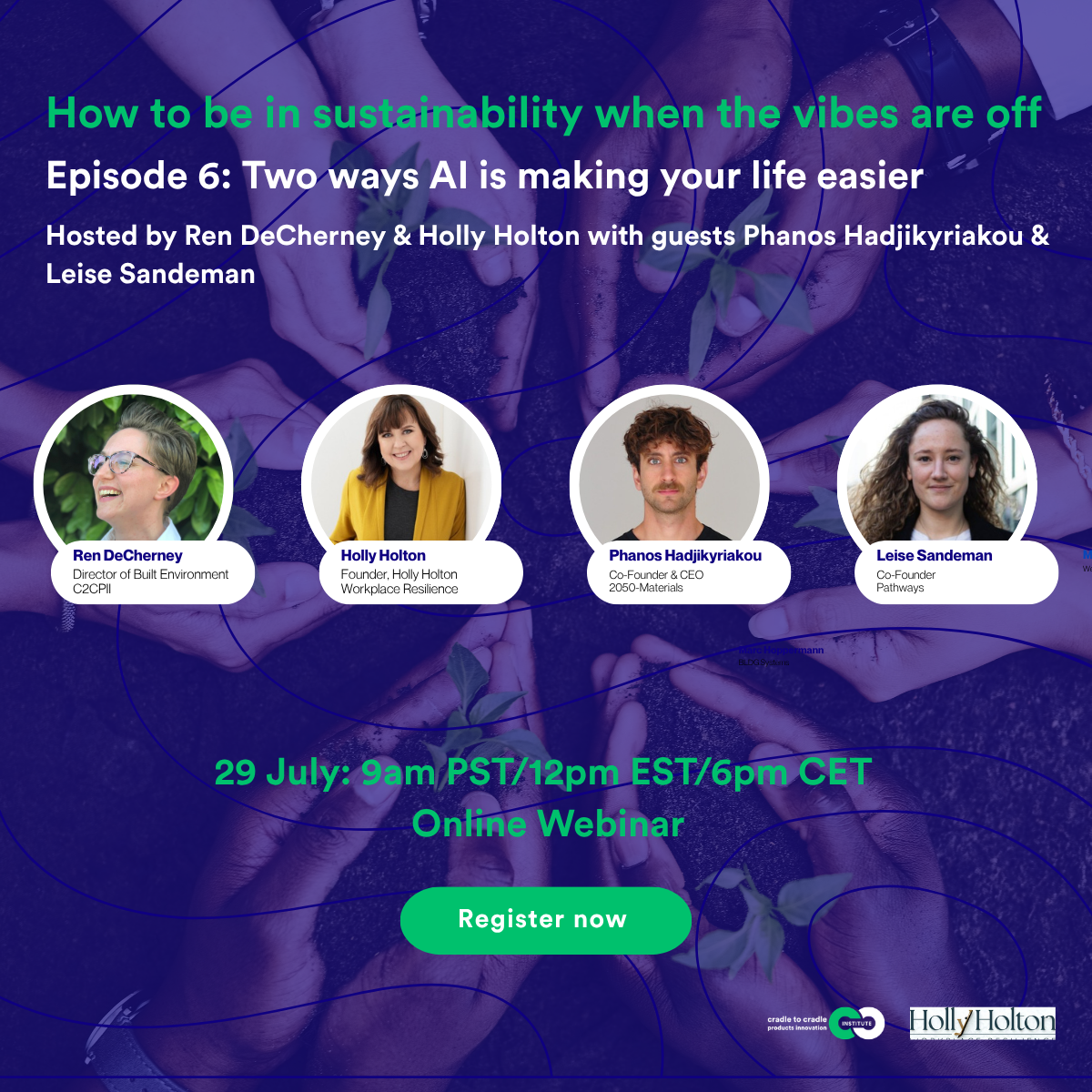
Ep.6: Two ways AI is making your life easier from "How to be in sustainability when the vibes are off"
Key Takeaways
It’s less about data and more about understanding
For Phanos Hadjikyriakou, founder of 2050 Materials, AI is already solving one of the built environment’s most persistent problems: fragmented sustainability information: Environmental Product Declarations, Health Product Declarations, circularity certifications, technical documentation, and other product information often live in lengthy PDFs and disconnected databases.
2050 Materials aggregates that information and makes it usable for designers, architects, engineers, and contractors. AI has become an important part of that process, particularly in extracting information from complex documents and connecting it to the systems professionals already use.
Sandeman's company, Pathways, works on the supply side with concrete producers, steel manufacturers, and chemical companies that need to generate EPDs but whose data is semi-digital, inconsistent, and spread across procurement systems. Where traditional solutions sent manufacturers an intimidating Excel to fill out, Pathways integrates directly with their systems, ingests whatever data exists in whatever form, and uses AI to do the matching that makes messy real-world inputs usable. When a supplier database lists "Master Builder" on one line and "MBS" on the next, a human reader connects them instantly. AI now does the same. The impact: hundreds of manufacturing plants generating environmental insights that enable supply chain decisions that were previously out of reach.
"One of those plants changing one supplier input material outweighs our total AI emission." — Leise Sandeman
Ren put the problem of disconnected data into stark terms: designers she has spoken with can spend four hours or more researching the material health of a single product. When a designer is responsible for specifying between 10 – 300 different materials per project, this is time that they just do not have. If the first four hours of sustainability work are spent simply finding the data, there is little billable time left to analyze what you found, and the speakers agreed that may be one of AI’s biggest opportunities in sustainable design.
Instead of replacing the designer’s and manufacturer expertise, AI could help clear away minutia of data collection work that prevents teams from applying it and implementing more sustainable solutions and innovative strategies.
AI can make sustainability more actionable but the environmental and social costs cannot be ignored
Holly, a former sustainability director who now works as a trauma-informed coach, admitted she comes to the conversation around AI as a skeptic. She emphasized that her concern isn’t abstract, but stems from the fact that AI depends on enormous data centers that consume energy and affect communities, which makes the sustainability case for AI complicated. Ren agreed that in addition to the environmental footprint, the power structure and incentives of the AI companies leaves her highly concerned about the potential social and economic downsides.
All the speakers agreed: we have to ask what resources are being consumed to make that computation possible and resist an easy narrative that AI can solve all the issues in an industry. Phanos and Leise also didn’t argue that every AI application is worthwhile. In fact, they suggested almost the opposite.
Phanos offered the test he uses: does the positive impact he is striving for by using AI meaningfully outweigh its environmental cost? For 2050 Materials, using AI to process hundreds of thousands of products and thousands of data points per product unlocks work that would be extraordinarily difficult to do manually. But using an unnecessarily powerful model for a relatively trivial task may not make sense.
He emphasized that designers should use the technology where it creates meaningful leverage: “a lot of us automate the stuff we don't like doing. That's fine. But the more important question is: what am I not doing today that I could be doing with access to this technology?"
The next era of sustainable design may be about … design!
Perhaps the most interesting idea to emerge from the conversation was about human judgment. Leise described a future in which AI makes certain aspects of building and designing dramatically easier. She argued if AI can rapidly generate options, visualize concepts, process data, and automate repetitive tasks, a designer’s differentiator may no longer be how quickly they can produce an option, but becomes knowing which option is worth pursuing.
Ren recognized the same dynamic from the design side of the conversation. AI may not have the taste, aesthetic judgment, or accumulated expertise of a trained designer. That could actually make designers more powerful if they use AI to eliminate data crunching work and spend more time doing the creative and strategic work they were trained to do.
"AI doesn't have great taste. Armed with the data analysis AI can provide, that's exactly where designers become more powerful, not less." — Ren DeCherney
The only way this works is with clear strategic thinking
Holly asked: if AI makes iteration essentially effortless, what’s to stop designers (or clients!) from endlessly iterating and rendering design meaningless? In her experience, unlimited options can make decision-making even harder.
She emphasized that good designers will learn to develop their own guardrails by knowing when something is good enough, when another iteration adds value, and when the technology is simply encouraging more consumption for diminishing returns. And the only thing that can do that is a good design eye.
Everyone in the conversation agreed: efficiency isn’t the same thing as impact. We shouldn’t use AI simply because we can, but we should know how to use it when it allows us to achieve something better, more meaningful, or previously impractical.
That distinction became the clearest piece of advice Ren uses in her own practice: am I using AI to be more efficient or to be more effective? We’ve been striving for more effective sustainability strategies for years – this is where we should focus our use of AI.
The future of sustainability will be better if sustainability professionals don’t sit this out
There is an understandable temptation for people working in climate and sustainability to reject something like AI with its significant environmental and footprints and social impacts.
Leise encouraged sustainability professionals not to opt out completely because if sustainability people opt out of AI entirely, the people developing and deploying the technology won’t incorporate our expertise and use cases.
She made the point that if people who care deeply about climate and biodiversity don’t experiment with AI, we may miss the opportunity to develop the applications that could make the technology genuinely useful for sustainability.
That doesn’t mean embracing AI uncritically, but it does mean getting close enough to the technology to understand it, challenge it, and shape how it’s used.
"If no one who is excited about the climate uses AI, we don't develop those use cases. It's not going anywhere. It's already changing how the next decades are going to look, fundamentally, we should be part of developing what it is used for." — Leise Sandeman
So, what should designers do now?
Ren and Holly asked Phanos and Leise for their advise on how designers and manufacturers should approach AI and get started. Here’s what they said:
First, experiment: understand what AI can actually do before deciding what it means for your work. See if you can solve an issue you’ve been having and if it makes it easier to optimize for sustainability.
Automate the tedious, but don’t stop there: Phanos was clear: don’t just use AI to eliminate the tasks you dislike, ask what becomes possible if those tasks no longer consume your time.
Keep your judgement: more options aren’t necessarily better options. Your expertise, taste, judgment, and values are still the most important part of the process.
Be intentional about environmental and social cost. Consider what model you’re using, how much computation a task actually requires, what you’re using it for, and whether the value created justifies the impact.
Let your mind wander!
Holly emphasized that at a moment when we are surrounded by digitization and AI is increasingly capable of generating answers, we need to protect our ability to think, wonder, question, and simply sit with an idea, which are critical skills in sustainability.
The good news is that Phanos had some great song suggestions to help get you in the right mindset to get started:
His favorite pump-up jams come from Larry Levan, a DJ from the 80s/90s
His current go-to song to spark creativity: Electronic music, especially Affix Twin