London Design Festival 2026 Recap
Key Takeaways
What are clients asking for? They’re not sure, but sustainability is on the table.
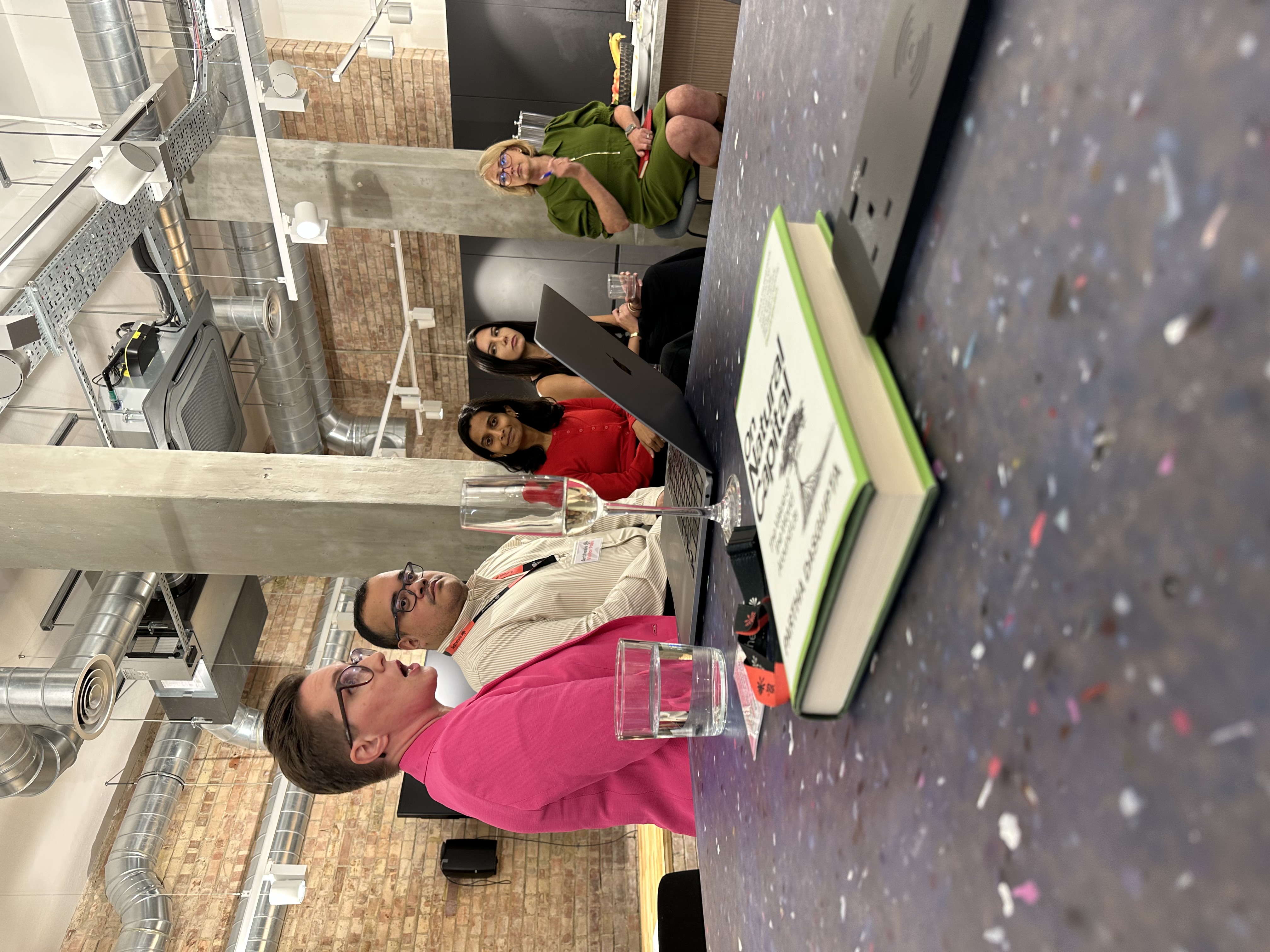
The discussion started with Ren asking the panel: what are your clients bringing to the conversation right now? The answer: it depends, and also everything. Clients range from those with fully articulated ambitions to others ticking a planning condition box to those who've said "make it sustainable" without a clear sense of what that means.
Alejandro Morales has worked with all of these types of clients: “A lot of the time clients are focusing on durability and cost, that’s undeniably the first thing that they want to look at and our challenge is to reframe that in terms of sustainability benefits. But also, a lot of clients just ask for sustainability as a general thing for the project, and they don’t exactly know what that means. We have to flush out what their priorities actually are.”
For Sarah Griffiths, helping clients define what “sustainability” means for them is a critical part of the project. For her clients it's multifaceted: “what are they going to prioritize? What do they score highly? What do we put the emphasis on? Getting that clarity so we can take it back to product manufacturers and then work to make their priorities work globally at scale is really what we work on with them.”
As designers, Alejandro, Suzanne and Rashmi noted they are the ones helping translate aspirations into a sustainability strategy that can designed, specified, priced, and built out. For them, that translation - the way sustainability gets framed - is the make-or-break point and becomes the most important part of their job.
Data, data, data: first, designers have to be able to find it
All of the panelists agreed they spend hours of their time working around the mismatch of data that manufacturers are producing and what designers can actually use. In order to translate the client aspirations into reality and get products specified, designers need data to be easily available. Then, they need it to be legible and comparable. Most importantly: put it where designers can find it!
"Vetting a new product for material health alone takes designers around four hours. And they specify between 15 and 350 materials per project. Nobody has time to just hunt for info." – Ren DeCherney
Suzanne outlined exactly what she’s looking for, saying “put it on your website, and even better if you also add a contact so I can ask specific questions. When you make that available, it’s easier for me to specify a product and connect it to the overall goals of the project.”
Rashmi emphasized that she needs a lot of verified data because products designated as “sustainable” are held to a higher standard: “within the transport industry, it's such a tricky balance between cost, aesthetics, comfort, performance. The balance is so tricky and it's almost like a sustainable material has to do better than anything that's a standard model. It has to prove that it can do all the things. It's a lot to ask and it's a lot, especially as a growing industry, it's really challenging.”
What types of documents help them do this? EPDs, C2C Certified®, and 3rd party verified information came up as the most important documents they look for when they vet products.
Context matters: giving numbers meaning
One of the biggest difficulties in translating sustainability metrics into action is that many of the metrics designers are comparing are not aligned. For instance, when evaluating a single product type, Suzanne described having to spend hours normalizing data across documents just to compare options fairly. This becomes a systemic industry chokepoint that makes it impossible to scale sustainability work.
Suzanne illustrated how this affects a project, explaining “we're looking at so many different variables and with greenwashing being such a big deal, you really have to tease through the data to see the full picture. And for someone that's not as literate in it, they can't translate it and it creates a barrier. It becomes an extra headache, it's an extra step, and at the end they end up being exhausted.” The panelists all emphasized that numbers are good, but it’s even more helpful if manufacturers translate it into something tangible that will help them connect it to the project goals.
What are some effective ways they’ve seen manufacturers tackle this? Case studies, infographics, and contextualizing info into stats people understand (number of trees saved, pollution reduced, etc) makes their life so much easier, and helps other team members take sustainability and run with it.
Turning numbers into authentic storytelling is what really moves the needle
Collectively, the panel agreed that reframing metrics into contexts that matter for a client is the most effective strategy for getting sustainability initiatives across the finish line. A great way to do this, Ren suggested, is that “instead of asking a manufacturer whether they have an EPD, an HPD, and a Cradle to Cradle certification, what if the designer said: ‘my client wants to remove harmful chemicals from this space. What can you help me with?’”
Outcome-framing rather than chasing single metrics changes everything. It makes budget conversations easier (you can't cut the thing that directly supports project goals). It makes the sustainability decision feel less like a checklist and more like design intent so collaboration becomes easier and progress is easier to deliver and measure.
This is only possible when a manufacturer has verified data and has connected it to tangible outcomes that reflect their authentic brand story. “Designers have a very finely tuned greenwashing detector, and they will know when there’s not much behind a number or a vague statement. Manufacturers should find the thing that is real to your brand, talk about it, and it will resonate to designers” said Ren.
For Sarah and her global clients working on large-scale high-impact projects, working with manufactures who have made actual achievements and the verified certifications to back up their claims is what gets them on a project. “Sustainability is the differentiator and it just shows in terms of commerciality how important it is to have the sustainability potentials out there front and center and commercial decisions are being based on that information.”
Sustainability successes happen when designers are able to combine verified data and metrics with storytelling that make the benefits tangible for clients. Manufacturers who are able to help them do all of that translation work are the ones who will get specified.
ABOUT THE PANELISTS
Sarah Griffiths, Associate Director, Anthesis Group
Sarah is a Principal Consultant at Anthesis with 15 years’ experience in resource management and circular economy strategy. Over the course of her career, Sarah has worked for product manufacturers to increase recyclability, with local authorities to improve recycling rates and with waste management companies to design environmental reporting systems. Since working in consultancy, Sarah has worked with multiple clients, across manufacturing, aviation, healthcare, construction, and finance to implement circular economy strategies that focus on reducing resource use and transitioning to circular business models.
Alejandro Mar Morales, Senior Sustainability Engineer, Cundall
Alejandro Mar Morales is Cundall’s Whole Life Carbon and Circular Economy Lead, specializing in sustainable building design, circular economy, material health, and whole-life carbon strategies for complex developments. Alejandro works across a diverse range of commercial, residential, and regeneration projects, helping clients deliver high-performing, low-carbon buildings while aligning with ambitious sustainability and net-zero objectives. Drawing on extensive experience in circular economy and resource-efficient design, Alejandro supports project teams in embedding sustainability throughout the design and delivery process, from early-stage concept development through to completion. Alejandro is passionate about translating sustainability ambitions into practical, data-driven solutions that create long-term environmental and social value.
Rashmi Bidasaria, Senior Designer, PriestmanGoode
Rashmi is a Senior Designer at PriestmanGoode. After gaining an MA in Design Products at the Royal College of Art, Rashmi joined PriestmanGoode as a designer in 2021. Rashmi began her career as a qualified architect and has made valuable contributions to a range of projects in spatial and product design and CMF. Since joining PriestmanGoode, she has worked on projects in the aviation, rail, cruise and hospitality sectors and for private clients, specializing in leisure and hospitality design. Rashmi was involved in Ecological Citizens, a collaboration with the Royal College of Art, with the mission to foster and proactively encourage ecological citizenship for positive climate action..At PriestmanGoode, she champions 'sustainability through design' internally, seeking ways that design can influence circular and sustainable solutions.
Suzanne Ries, Senior Sustainability Specialist, M Moser
Suzanne Ries is a Senior Sustainability Specialist at M Moser, focusing on the intersection of engineering, technology, and sustainability? My background is in both sustainable architecture (new builds) and adaptive reuse (renovation and reuse). She has a Bachelors of Science in Sustainable Built Environments, a major she helped create, at the University of Arizona and. Master of Arts in Historical and Sustainable Architecture from New York University. She has been implementing sustainable strategies successfully in projects since graduating in 2020.
Ren DeCherney, Director, Built Environment at Cradle to Cradle Products Innovation Institute
Ren DeCherney is a licensed interior designer and the Director for the Built Environment at the Cradle to Cradle Products Innovation Institute. She works daily at the intersection of design practice and material health — helping manufacturers understand what designers are asking for, and helping designers understand what they can ask of manufacturers. She is also the creator of FETCH, an AI-powered material health tool developed under the C2C Certified brand to help design teams vet products faster and with more confidence. Her experience spans design practice in the US and Europe, giving her a firsthand view of how sustainability shows up differently by context, budget, and client.